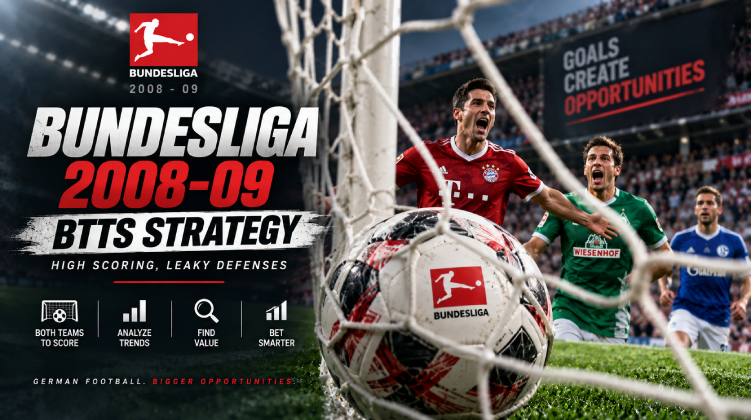
Bettors hunting for value often seek out asymmetric fixtures where a favorite holds overwhelming offensive dominance, yet this dynamic frequently leads to compressed, unappealing moneylines. The 2008–09 German Bundesliga offered an ideal tactical landscape for an alternative approach: the Both Teams to Score (BTTS / Goal-Goal) market. Throughout that high-scoring campaign, several clubs paired world-class attacking efficiency with profound defensive instability, routinely breaching opposing defenses while surrendering high-value scoring chances at their own end. Analyzing teams that reliably find the net while failing to keep clean sheets provides bettors with an analytical edge that bypasses outright match-winner volatility entirely.
Why Did the 2008–09 Bundesliga Produce Extreme BTTS Profiles?
German football during this era underwent an aggressive philosophical shift toward vertical transitions, counter-pressing, and aggressive wing-back deployments. Teams across the division prioritized overloading the attacking third over structural rest defense, leaving immense spatial cavities between the midfield and center-backs when possession was lost. This systemic posture ensured that even lower-ranked opponents enjoyed clear transitional lanes to launch counter-strikes.
Bookmakers frequently adjusted for this environment by lowering odds on over 2.5 goals, but they were slower to penalize BTTS lines for clubs whose structural flaws specifically invited two-way scoring. When a high-scoring side lacks the defensive personnel to absorb counter-attacks, match flow naturally tends toward end-to-end exchanges. Backing both teams to find the net became a far more sustainable strategy than laying heavy odds on volatile outright spreads.
How Werder Bremen Became the Quintessential BTTS Engine
Thomas Schaaf’s Werder Bremen was the premier example of this tactical contradiction during the 2008–09 season. Boasting an elite creative midfield featuring Diego and a young Mesut Özil alongside Claudio Pizarro up front, Bremen generated 64 league goals. However, Schaaf’s refusal to deploy an anchoring defensive midfielder left their backline completely exposed, resulting in 60 goals conceded across 34 matches.
Reviewing the defensive integrity and offensive output of prominent high-event clubs clarifies why standard clean-sheet projections continuously failed to capture the structural volatility of these teams:
| Club | Matches Played | Goals For (GF) | Goals Against (GA) | Clean Sheet Count | BTTS Match Rate (%) |
| Werder Bremen | 34 | 64 | 60 | 6 | 70.6% (24/34) |
| VfB Stuttgart | 34 | 63 | 43 | 7 | 64.7% (22/34) |
| Bayern Munich | 34 | 71 | 42 | 10 | 58.8% (20/34) |
| Hannover 96 | 34 | 49 | 69 | 4 | 61.8% (21/34) |
| 1899 Hoffenheim | 34 | 63 | 49 | 8 | 58.8% (20/34) |
The figures confirm that Werder Bremen and Hannover 96 operated as near-automatic BTTS selections, with Bremen registering two-way scoring in over 70% of their league fixtures. Hannover combined moderate scoring potency with the worst defensive record in the division outside the relegation zone, keeping a clean sheet in barely one out of every eight fixtures. Bettors who avoided the trap of predicting whether these inconsistent clubs would win or lose extracted dependable returns by solely isolating their structural inability to keep clean sheets.
The Mechanics of Midfield Vacancy
Bremen’s tactical design pushed both fullbacks beyond the halfway line simultaneously while the central midfielders drifted toward the ball carrier. When an opposing team intercepted an errant pass, they immediately faced an unshielded back two, creating two-on-two or three-on-two breaks with wide-open crossing angles.
Opposition Finishing Variance Under Spatial Freedom
Because counter-attacking opponents routinely broke through with numerical superiority, the quality of chances conceded was exceptionally high. Opposing strikers did not need high shot volume; they regularly converted low-quantity, high-probability opportunities that rendered clean-sheet wagers systematically unprofitable.
Bayern Munich Under Klinsmann: Elite Talent Without Defensive Cohesion
Jürgen Klinsmann’s tenure at Bayern Munich was defined by exceptional individual attacking quality masking erratic defensive coordination. The squad possessed sufficient talent in Franck Ribéry, Luca Toni, and Miroslav Klose to score against any low block in Europe, ensuring they found the net in the overwhelming majority of their fixtures. Yet, their transitional shape was so fragile that modest traveling sides regularly scored at the Allianz Arena.
Bettors who backed Bayern on traditional moneyline odds frequently suffered devastating losses when an underdog snatched an equalizer against the run of play. Conversely, recognizing that Bayern’s backline surrendered recurring set-piece and counter-attacking opportunities allowed sharp bettors to pivot toward BTTS at attractive prices. Backing an offensive heavyweight to score while simultaneously banking on their defensive fragility provided a far more mathematically sound approach than laying short odds on clean sheets.
A persistent gap between public perception and on-pitch defensive reliability naturally directs analytical bettors toward dedicated wagering avenues that provide competitive derivative pricing. When market observers identify a prominent club displaying relentless attacking output alongside an inability to protect its own penalty box, placing positions through an adaptable betting platform operated by ufabet เว็บตรง ทางเข้า มือถือ enables sharp bettors to capture optimal BTTS odds before trading desks adjust for defensive liabilities.
The Physical Collapse of 1899 Hoffenheim’s Second-Half Defense
During their maiden top-flight season, 1899 Hoffenheim captivated neutral observers with a ferocious high-pressing system that produced rapid offensive returns. While this vertical aggression guaranteed a steady stream of early goals, the immense physical taxation of their pressing structure created an inevitable consequence during the final thirty minutes of matches.
Relentless High-Pressing Energy Invested in First Half
│
▼
Early Lead Established via High Turnovers in Attacking Third
│
▼
Severe Aerobic Depletion After the 60th Minute Mark
│
▼
Midfield Line Drops / Back Four Left Structurally Isolated
│
▼
Opposition Inevitably Pulls a Goal Back via Late Transition
This sequence illustrates why Hoffenheim’s matches became reliable BTTS territory, particularly in the second half of the season. Once opposing managers realized Hoffenheim could not sustain their intense pressing over full ninety-minute cycles, they instructed their players to absorb early pressure and exploit tired legs late, ensuring both sides registered on the scoresheet.
Tactical Triggers That Validate a Pre-Match BTTS Position
Isolating a profitable BTTS fixture demands rigorous screening rather than blindly selecting two teams that recently played in high-scoring games. The presence of goals does not automatically make a matchup suitable for two-way scoring; the goals must stem from specific tactical incompatibilities.
- Verify Consistent Offensive Baseline: The favored side must average at least 1.5 goals scored per ninety minutes across their previous eight fixtures.
- Identify Fullback Vulnerability: The favored team should feature offensive fullbacks who consistently leave their defensive flanks vacated during transitions.
- Assess Underdog Counter-Attacking Speed: The opposing underdog must possess at least one winger or central striker capable of carrying the ball directly into open space.
- Inspect Center-Back Pace Deficits: Slow, aerial-dominant central defenders are prime targets for agile opposing forwards operating on the counter.
Maintaining strict analytical standards ensures that bettors avoid placing wagers based on superficial intuition or excitement. The psychological restraint needed to bypass standard match-winner markets in favor of a data-driven BTTS position mirrors the emotional discipline required when participating on an interactive casino online portal, where long-term capital preservation hinges entirely on executing mathematically favored edges rather than chasing speculative thrills.
When Does the BTTS Strategy Collapse?
Even when underlying metrics strongly indicate that both teams should score, certain contextual conditions can dismantle the expected match dynamic. The most prevalent failure point occurs when the underdog adopts an ultra-conservative defensive setup that completely abandons attacking intent, opting for an extreme low block that generates zero offensive output.
If the weaker side refuses to commit even two players forward on counter-attacks, the favored team can dominate possession without facing transitional risk, resulting in a sterile 1–0 or 2–0 victory. Additionally, wet pitch conditions or early weather-related friction can severely degrade passing accuracy, killing the fast transitions required for underdogs to capitalize on open space. Bettors must verify that the underdog possesses both the managerial ambition and the tactical capability to contest the match rather than simply playing for damage limitation.
Summary
Handicapping the Both Teams to Score market in the 2008–09 Bundesliga provides an enduring lesson in evaluating systemic defensive imbalance. Teams like Werder Bremen, Hannover 96, and Klinsmann’s Bayern Munich demonstrated that exceptional attacking metrics paired with neglected transitional defense create the ideal mathematical environment for two-way scoring. By analyzing spatial concessions, monitoring physical decay across ninety minutes, and fading the flawed assumption that elite favorites automatically keep clean sheets, disciplined sports bettors can systematically unlock profitable value across modern goal markets.