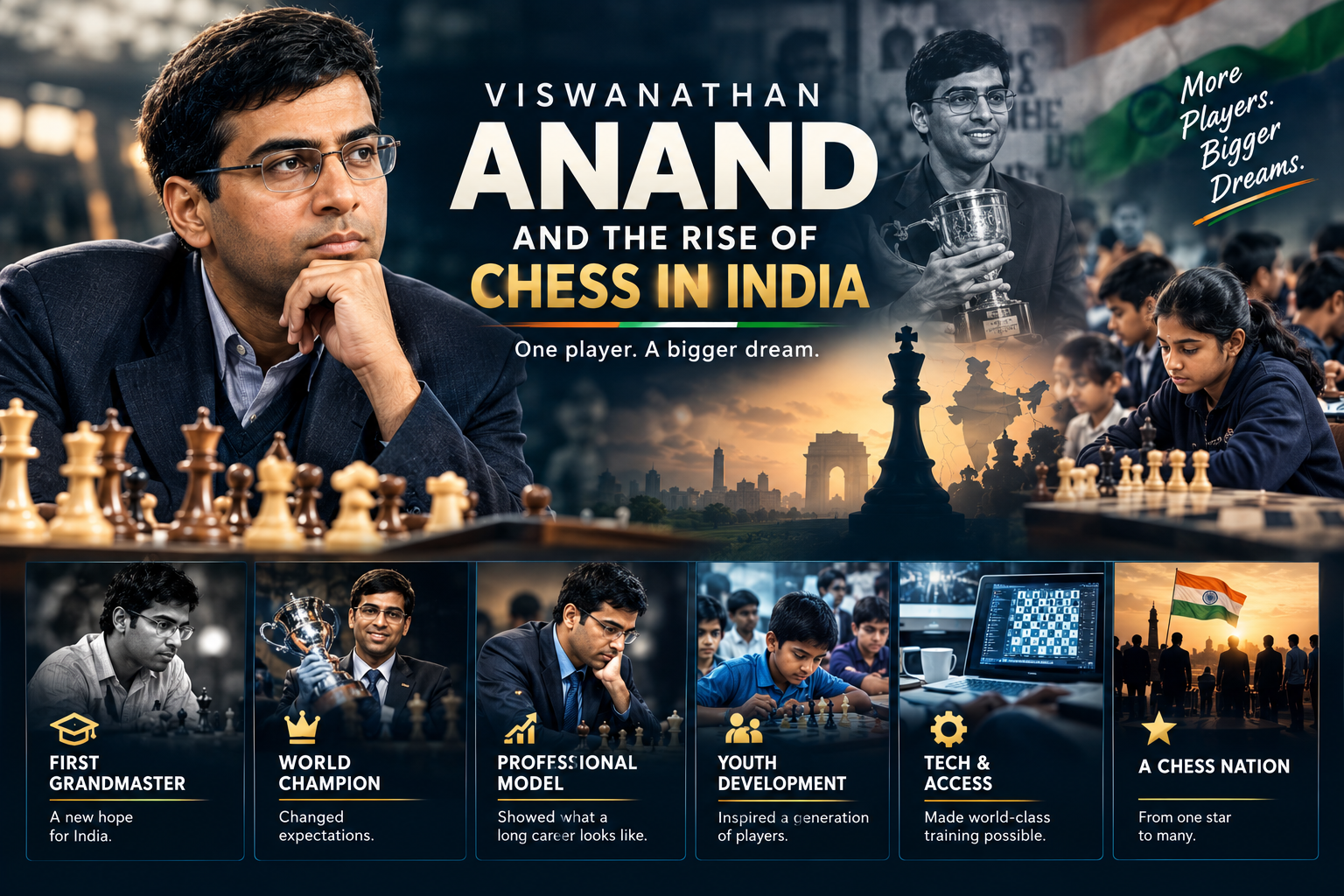
India’s rise as a major chess nation cannot be explained by one player, but Viswanathan Anand occupies a central position in that development. Before his emergence, India had a chess tradition and an organized competitive structure, yet few players could imagine a direct path from domestic tournaments to the top of world chess. Anand changed that perception. By becoming India’s first grandmaster in 1988 and later reaching the world championship level, he provided evidence that an Indian player could build a career at the highest level of the game.
His influence also arrived as entertainment habits were becoming more fragmented. Today, someone can move from a chess broadcast to a sports discussion or an unrelated online format such as money time pragmatic play within minutes, which makes attention a resource every sport must compete for. Anand helped chess secure a place in India’s sporting conversation because his results gave audiences a reason to follow tournaments that might otherwise have remained specialist events.
The Importance of Becoming India’s First Grandmaster
A grandmaster title represents more than a ranking milestone. It requires results against strong international opposition and demonstrates that a player can compete beyond the national system.
When Anand became India’s first grandmaster, he created a reference point for younger players.
Before that achievement, the route to elite chess could appear distant. Players needed access to tournaments, coaching, study material, and opponents strong enough to support development. Anand’s success did not remove those obstacles, but it made the destination visible.
That psychological effect matters in sport. A pathway becomes easier to imagine once someone from the same competitive environment has completed it.
Speed Became Part of Anand’s Identity
Anand became known early in his career for playing quickly. His speed was not simply a matter of moving pieces faster than opponents. It reflected pattern recognition and calculation developed through repeated competition.
This characteristic also made his games accessible to spectators.
Chess can appear slow to audiences unfamiliar with strategic planning. A player who makes decisions rapidly creates a different viewing rhythm. Anand showed that high-level chess could combine calculation with pace.
His strength in faster time controls later reinforced that image.
For young players, this demonstrated another lesson: intuition in chess is not the opposite of preparation. Fast decisions are often possible because thousands of positions have already been studied.
World Championship Success Changed Expectations
Anand’s influence expanded when he moved from being an elite Indian player to becoming a world champion.
That distinction matters.
Producing a grandmaster shows that a country can develop an international-level competitor. Producing a world champion changes expectations about the upper limit of what future players can achieve.
Anand won world titles across different championship formats and defended his position against players with contrasting styles. This required more than tactical ability.
World championship preparation involves opening research, opponent analysis, physical routine, psychological control, and the management of long matches.
Indian players could therefore study not only Anand’s moves but also his approach to chess as a profession.
A Professional Model for the Next Generation
One of Anand’s most important contributions was demonstrating what a sustained chess career required.
Talent can produce early results, but elite competition demands systems.
Players need opening preparation, endgame knowledge, analytical support, tournament planning, and methods for recovering after losses. They also need to adapt because opponents can study previous games.
Anand remained relevant across several generations of competitors.
That longevity offered young Indian players a model different from a short period of success. It showed that chess development continues after reaching grandmaster level.
The goal is not simply to obtain a title. It is to keep improving after opponents already understand how you play.
The Grandmaster Pipeline Began to Expand
Anand did not single-handedly create India’s chess infrastructure. Coaches, families, clubs, federations, organizers, and players all contributed to its development.
His success, however, gave that system a visible figure around whom interest could grow.
As more children entered chess, the competitive base expanded. More tournaments meant more opportunities to gain experience. More strong players created stronger training environments.
This produces a reinforcing cycle.
A country with several strong players gives developing competitors access to demanding opposition without requiring every stage of progress to happen abroad.
India gradually moved from celebrating one grandmaster to producing many.
Technology Accelerated a Process Already Underway
The spread of digital chess tools transformed training.
Players gained access to game databases, engines, online competition, recorded lessons, and opponents from other countries. Geography became less restrictive.
India was well positioned to benefit because interest in chess had already expanded.
Anand’s generation often needed more effort to access international competition and information. Younger players could study elite games almost immediately after they were played.
Technology therefore did not create India’s chess culture from nothing. It accelerated a development process for which Anand had already become a symbol.
Anand’s Influence Extended Beyond His Own Games
A sporting pioneer has influence when later generations no longer need to follow exactly the same path.
That is visible in Indian chess.
Younger players have developed different styles, training methods, and career trajectories. Some reached elite levels at ages when earlier generations were still trying to obtain international exposure.
Anand’s importance is therefore not based on producing copies of himself.
His career expanded the range of outcomes Indian players could consider realistic.
From Individual Success to a Chess Nation
The chess boom in India resulted from many forces: coaching, family investment, tournament structures, technology, stronger competition, and the work of generations of players.
Viswanathan Anand became the bridge connecting many of those forces.
His first grandmaster title established a precedent. His world championship success changed expectations. His longevity demonstrated how a chess career could be managed, while his visibility helped move the game beyond a limited competitive audience.
That is why Anand’s legacy cannot be measured only through titles or individual games.
His career changed the environment around Indian chess. The strongest evidence is the generation that followed: players who grew up in a country where becoming a grandmaster was no longer an unprecedented achievement and competing with the world’s best no longer seemed like an impossible destination.